- Offen: School building with 3 classrooms
- Offen: Toilets
Sinazongwe District · Southern Province, Zambia
Nzenga Community School
In Nzenga, a village on Lake Kariba in southern Zambia, around 300 children still learn without a proper classroom. Lessons take place in shelters made of wooden poles, corrugated iron and old sacks, or in the shade of a baobab tree. Together with the village community and our partners on the ground, we are now preparing to build a block of three classrooms. Construction is planned for the 2027 dry season.
- ~300 pupils
- 5 volunteer teachers
- 3 new classrooms
- 2 government teachers promised

Learning under corrugated iron and baobabs
Nzenga lies on the shores of Lake Kariba, without electricity or running water. The government schools are too far away for many children. Some already walk up to seven kilometres today, and in the rainy season the route to Sinazongwe crosses a large river. That is why the village founded its own school in 2021, and since 2025 it has been officially recognised.
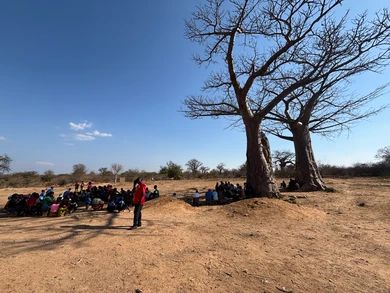
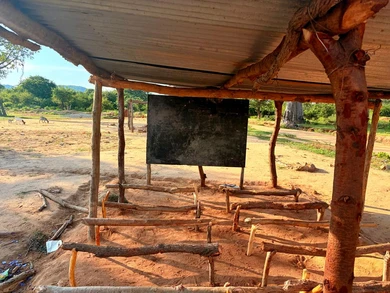
There is still no permanent building. The children learn in open shelters made of wooden poles, corrugated iron and old sacks, or in the shade of a baobab with the blackboard hanging from its trunk. They sit on logs and bricks, and when it rains, lessons are often cancelled. And yet, learning happens here. Five volunteers teach the children, so far without pay.
The plan is a classroom block based on the Ministry of Education's standard design, with three classrooms, offices, storerooms and covered verandas. In the mornings, Grades 4 to 6 will learn there, and in the afternoons Grades 1 to 3. Conduits are included for a future electricity connection. And the baobabs, under which lessons are still held today, are to be preserved wherever possible.
A village that believes in its children
In 2025, the parents in Nzenga made mud bricks with their own hands to finally build classrooms for their children. Then the rain came and destroyed the bricks and the foundation trenches. Yet they did not give up. When we sat with the village under the baobabs in September, a large pile of sand was already waiting there, brought in by the community for the new building. That moved us deeply.
During construction, they will clear the site and help dig the foundations. A family has given the school its land free of charge, and a borehole has already been drilled. When the classroom block stands in 2027, their work will be part of it.
What three rooms change
For around 300 children, it means being able to learn reliably for the first time, come rain or shine. As soon as the block is finished, the education authority will send at least two trained teachers paid by the government. It has confirmed this in writing. School furniture is also set to follow.
Where children are allowed to learn, a different future begins.

“The new classroom block is a real gain for the whole community in Nzenga. The village will come out of this project stronger. I am delighted to be carrying out this project with Forest creates Future.”
Progress so far
What is planned
- Offen: School garden with borehole
The project is funded by the Reiner Meutsch Foundation FLY & HELP. We are very grateful for this.